
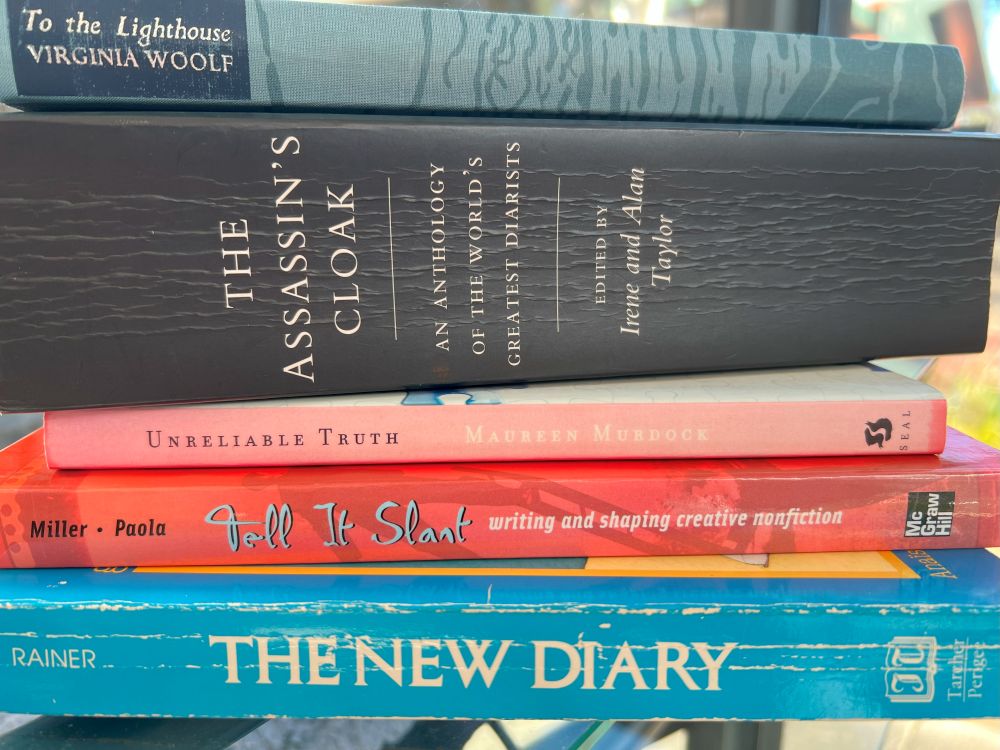
My creative writing genres include poetry, creative non-fiction and personal essay. Fiction is not my forte when it comes to writing. So here are 5 books which expanded my writing.
1. ‘The New Diary: How to use a journal for self guidance and expanded creativity’ Tristine Rainer (1978) Tarcher Perigree, New York
As a young woman, I found this book before I studied creative writing at RMIT. I read it before I knew what I wanted to do in life. Before I had really thought about who I was as a person. This book was a revelation. Rainer’s chapter titles include ‘The Diary as a Time Machine’; ‘Rereading the Plot of your Life’; ‘Dream Work’; ‘Eroticism’; and ‘Transforming Personal Problems’. This is NOT a ‘dear diary’ book. It challenges the reader to experiment and explore. Just what I needed at the time.
2. ‘Tell It Slant: Writing and Shaping Creative Non-fiction’ Brenda Miller and Suzanne Paola (2004) McGraw Hill, New York.
This clever volume is a combination of techniques and anthology. Each technique is demonstrated by including innovative work from a range of creative non-fiction writers. I absolutely loved discovering the various forms of personal essay writing. These include the Lyric Essay, the Hermit Crab Essay, the Braided Essay and more. Written when creative non-fiction was emerging into popular reading, it is a great resource.
3. ‘Unreliable Truth: On Memoir and Memory’ Maureen Murdoch, (2003) Seal Press, New York.
Have you ever been in a room with friends or family, recounting a memory, and everyone in the room recalls the event differently? Murdoch explores notions of emotional truth as distinct from factual truth. This book explores the idea that even when we try to write factually, we are writing only our own perspective. Any form of life writing, by nature, has to be crafted because it is not physically possible to include everything that happened, even if we could remember it accurately.
4. ‘The Assassin’s Cloak: An Anthology of the World’s Greatest Diarists’ Irene and Alan Taylor (Ed’s) (2000) Canongate Books, Edinburgh
Organised by days within months, this book works from 1st January to 31st December with each day covering centuries. Pulling together key events and intimate reflections from writers in the moment. This book is a reminder of the importance of keeping historical records, even if the importance is not clear at the time.
5. ‘To the Lighthouse’ Virginia Woolf (originally published in 1927) Hogarth Press, London
I read this book so long ago, and recently, on re-reading it, I realise how ground-breaking it was. Although it is fiction, Woolf tries to write in the impressionist style. She captures in glimpses, the many layers of life as it happens. Integrating thoughts, actions and observations in single sentences, it’s a demonstration of the ‘unreliable truth’ examined by Maureen Murdoch. Brilliant introduction in my copy by Gilbert Phelps who unpacks some of the context of the novel, and Woolf’s process. My copy is a reprint with watercolour illustrations published by The Folio Society, printed in 1988.

More Books to Come!
Stay posted by following me. You can do that at the bottom of this page. I plan to write a future post on artists and art books I found inspiring. You can read more in the 100 Days of Art project here.


Leave a Reply