
For me, painting is a combination of intuition, knowledge and emotion. None of this is conscious when I pick up my paints and brushes. The ideas are not conscious, and I have no idea what will emerge on the canvas. The commonly used term for this is intuitive painting.
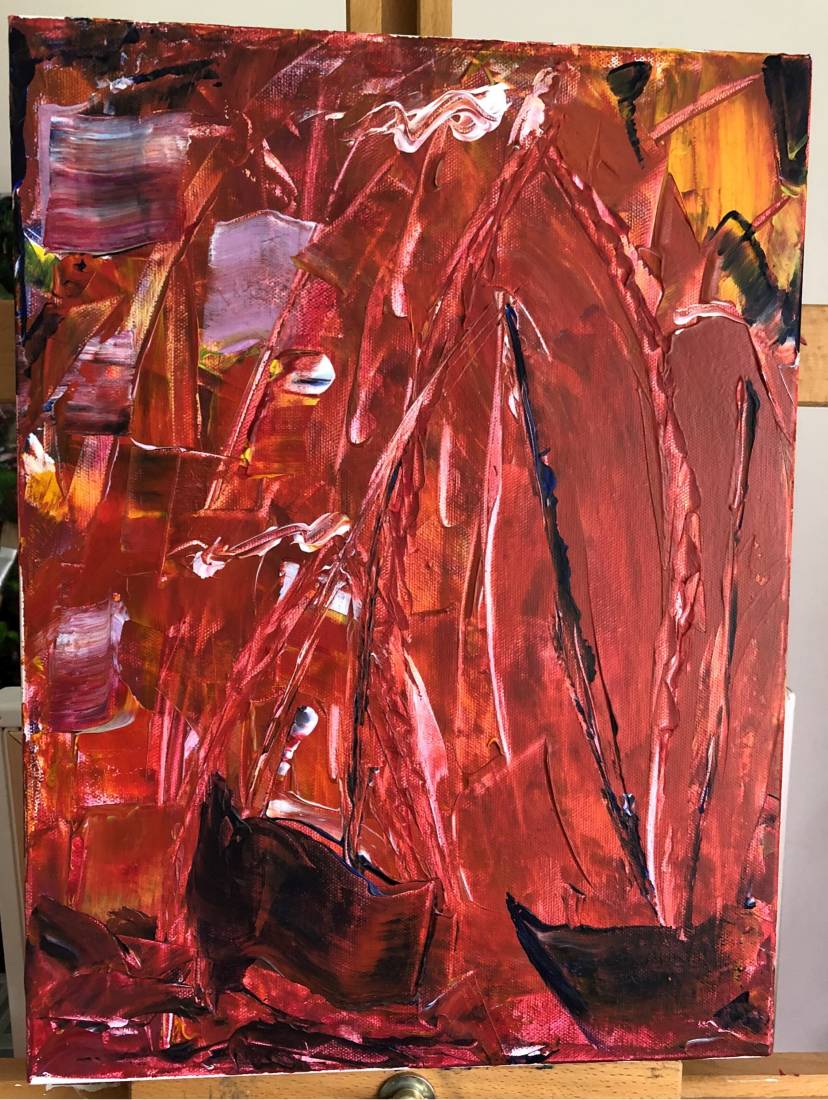
A typical example is my painting ‘Red Sails’.

The Beginnings of ‘Red Sails’
The purchase of a flat silicone tool, approximately 5 cm wide, saw the beginning of a work about boats. Something not usually in my repertoire. I primed a very small canvas and decided to start with red acrylics. The choice of red was not planned. It just appealed to me on the day. The magic happened when I picked up the new tool and made two quick strokes on the canvas. I had dipped it the flat silicone blade into some deep blue paint named ‘Midnight Harbour’. This colour stood out against the red. Stepping back, I recognised two curved hull shapes. Both improvised with a flick of the wrist. I didn’t intentionally paint hulls.
Instantly I knew I was painting sailing ships at sunset.
Intuition and Experience
Intuitive painting is a widely used term. When I first started painting, I was referred to the work of Flora Bowley. Immediately, I bought Flora Bowley’s book ‘Brave Intuitive Painting’.
Thinking of myself as an intuitive painter gave me permission to paint freely. Before that, I was afraid of a blank surface. In my head, I thought I had to conceptualise a perfect image and transfer it to the canvas. It was the realisation that the decisions I made were the key to my personal style. The magic came from the colours I chose. The texture of the work. How I chose to make other marks. The doors of imagination were flung open and I painted – my way. Wow! What a gift!
But ideas don’t come from nowhere. Nor did ‘Red Sails’. I grew up in a coastal city. Boats were part of my normal environment. My grandmother lived in Queenscliff on the Bellarine Peninsular. Each year we watched the Melbourne to Hobart yacht race fleet sail through Port Phillip Heads. As soon as I interpreted those two ‘Midnight Harbour’ deep blue strokes as hulls. As soon as I saw the background red, I knew what I was painting. The elements were all in my head. All I had to do was interpret them in my own style.
Intuition and Emotion
When I start any painting, it is always from the emotion of the day. A colour will jump at me. I never question this. Depending on my mood, I sometimes splash it on thickly, creating texture straight away. Other days I might mix a couple of colours, or use a transparent wash. If my energy is itching to be released, I paint fast. If I’m tired, perhaps I’ll work slowly and try to lay down a background of large unformed shapes.
The paint palette I use the most is encompassed in my branding. The yellow-green, dark red, gold, orange and deep blue-green are my most frequently used colours. I don’t know why, but often I step back from a painting, evaluating if it is finished or not. “I think it needs some orange” comes to mind. Orange is not my favourite colour, but it seems to have an important role in my work.
Bringing It All Together
At some point, the painting moves from intuitive to a more conscious state of mark making. At that point when knowledge comes into the picture, the marks are more planned. The colours more consciously allocated.
In ‘Red Sails’ I’ve represented the sea, and the lights and buildings on the shore behind the sails. The red could be shore lights, or it could be a sunset. Or it could be both, at that time of the evening when cities begin to illuminate. This is when the viewer’s intuition, knowledge and emotion comes to the fore. Each person can interpret the context in their individual way.
I’ve put ‘Red Sails’ up for sale on my Bluethumb page. There are photographs showing more details of the work.
If you enjoyed reading this post, you can see more in the 100 Days of Art series here.

Leave a Reply